Energy Scholarship Fund
Funding our Future
In the decade ahead, the energy sector expects to face historic hiring demands to power and fuel an energy evolution. The vast majority of individuals that will be hired will seek education and training to gain crucial skills and knowledge to prepare for those careers. But the cost of those programs remains a common barrier, limiting both individuals’ access to rewarding careers in energy and the sector’s ability to secure the talent it needs. It’s time to address this challenge with haste.
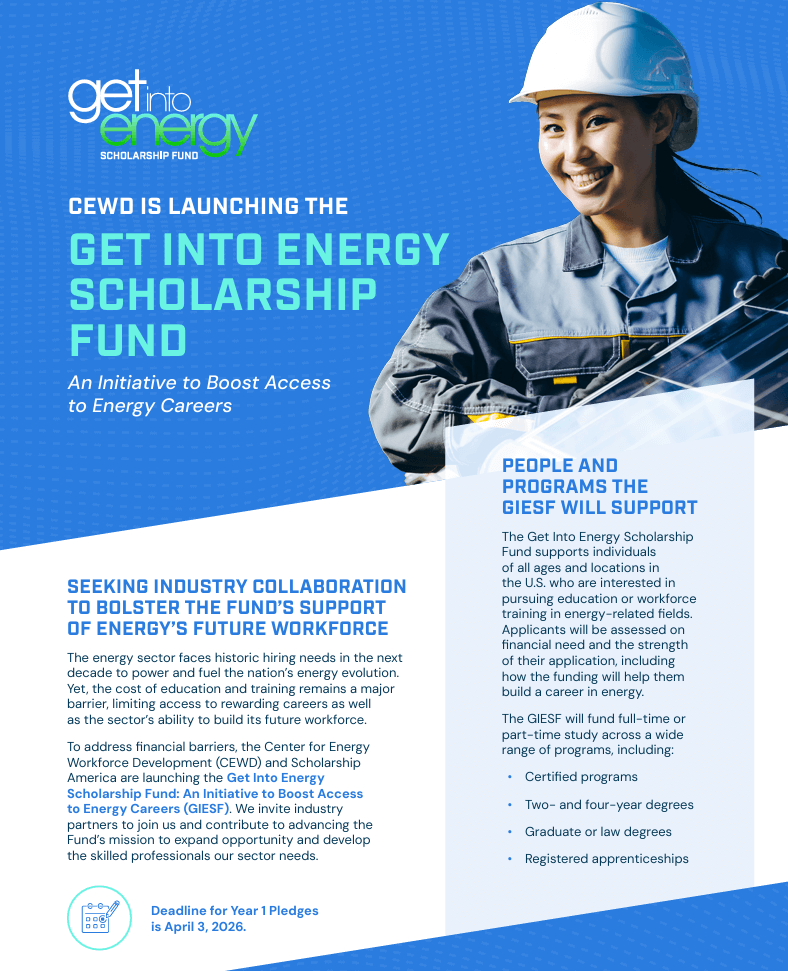
The new Get Into Energy Scholarship Fund, an initiative to boost access to energy careers, is providing the response and leadership the industry needs. CEWD is proud to partner with Scholarship America, the largest scholarship administrator in the U.S., to bring the Scholarship Fund to life. We invite energy, workforce development, education, and philanthropic partners to support the Scholarship Fund’s mission.
Who and What the Scholarship Fund Will Support
The Scholarship Fund is geared towards people of all ages and in all parts of the country, especially those with demonstrated financial need, who are interested in pursuing education or workforce training in a field of study relevant to the energy sector. It will support full-time and part-time study across a wide range of program types, including those leading to two-year, four-year, and graduate degrees, certificates, as well as Registered Apprenticeship programs.
Program Structure
The Scholarship Fund, slated to open its first round of applications in Fall 2026, aims to be a one-stop hub for people pursuing energy-related scholarships to identify relevant opportunities.
First, it will aggregate existing scholarship programs currently offered in the industry (as approved for inclusion by the programs’ sponsors). If your organization runs or funds an existing scholarship program that you would like to include in the Get Into Energy Scholarship Fund’s offerings, contact [email protected].
Second, the page will present distinct scholarship sub-funds from which applicants can receive awards. This is where CEWD is especially asking for industry and philanthropic support. Sub-funds pool contributions from multiple organizations towards a shared goal, reflecting industry priorities, while also making it easier for applicants to access scholarships. The final slate of sub-funds will be determined based on the nature of financial contributions that the Scholarship Fund receives.Currently, CEWD is encouraging contributions to the following slate of distinct sub-funds:
- Get Into Energy Fund (General): This is a general fund intended to flexibly support people interested in pursuing rigorous, relevant education or workforce training programs and who may not be strong candidates for the other distinct scholarship funds.
- Urban Energy Scholarships: Supporting residents of urban communities that have participated in CEWD & National Urban League energy programs.
- Veterans Scholarships: Supporting veterans pursuing energy careers.
- Hire PowHER Scholarships: Supporting women pursuing energy careers.
- Boosting Apprenticeship Success (Emergency Aid Fund): Supporting participants in Registered Apprenticeship Programs to cover emergency one-time expenses that could jeopardize their ability to persist in their programs, such as child care, housing, transportation, food, or other immediate financial needs.
*Additional pooled funds may be added based on industry interest and support.
How to Support the Get Into Energy Scholarship Fund
There are four ways that energy, workforce, education and philanthropic stakeholders can support the Get Into Energy Scholarship Fund:
1) Contribute to one of the new Get into Energy Scholarship sub-funds. Organizations looking to bolster the Get Into Energy Scholarship Fund may opt to contribute to one or more of the sub-funds based on corporate strategies and priorities. Share your interest by contacting [email protected].
2) Incorporate your existing scholarship program that supports learners pursuing energy careers into the Get Into Energy Scholarship Fund. If you sponsor a relevant existing scholarship program, would like to have it listed on the Get Into Energy Scholarship Fund page, and/or learn about having it administered by Scholarship America, please let us know at [email protected].
3) Start a new Get into Energy sub-fund that aligns with your organization’s goals. There may be a sub-fund not identified that reflects an energy workforce priority for your organization. For example, the Get Into Energy Scholarship Fund could have a distinct scholarship fund that supports students pursuing careers in a specific energy subsector (e.g., nuclear, hydropower, natural gas, transmission, renewable energy technologies) or support learners in a geographic region.
4) Help spread the word about the Get Into Energy Scholarship Fund with this flier:
Strategies to Create Impactful Energy Scholarships
Scholarships can play a powerful role in building the future energy workforce. When thoughtfully designed, they do more than help students pay for education and training, they can expand access to high-quality career pathways, reduce barriers to completion, increase participation in occupations facing workforce shortages, and connect talented individuals to rewarding careers in the energy sector.
The following strategies highlight evidence-informed approaches that energy companies, foundations, associations, and other organizations can use to maximize the impact of their scholarship investments. From program design principles to partnership and outreach practices, these recommendations are intended to help scholarship sponsors create opportunities that not only support individual learners, but also strengthen the industry’s ability to attract, develop, and retain the skilled workforce needed to meet future energy demands.
Program Design Principles
1) Avoid only considering merit criteria in applications. Scholarships can be life-changing when they support people who might not otherwise pursue or complete a program that successfully prepares participants for rewarding careers. Some scholarships focus only on merit-based criteria (e.g. SAT scores, GPAs, leadership and work experiences, strength of personal statements, etc.). Others focus on need-based criteria (e.g. whether the applicant is part of a low- or moderate-income household). Some programs consider a combination of these factors.
Studies on the impacts of grant aid programs find that both merit-based and need-based aid programs can have positive impacts, ranging from increased enrollment, to higher rates of program completion, to increased enrollment of underrepresented populations in STEM fields of study. But, need-based programs tend to produce greater positive impacts than merit-only programs.
Many programs incorporate both need- and merit-based criteria to achieve a combination of goals, i.e. supporting students with demonstrated financial need who may not otherwise pursue the targeted programs, while also targeting students with strong academic foundations on which to succeed in the programs.
2) Target education and workforce training programs that have strong outcomes for students, and do not rely only on accreditation as a proxy for high-quality. Many private scholarships limit eligible programs to those at education institutions that are accredited. Accreditation means that the program has sought and maintained recognition from an independent accrediting body that is intended to evaluate higher education and workforce training programs on their quality, across a wide array of measures. Accreditation is part of a process that allows schools to be eligible for federal financial aid programs, such as Pell Grants and federal loans.
It is important to understand that accreditation does not guarantee a high-quality program. The nonpartisan research organization Third Way points out “Agencies consistently accredit colleges with abysmal student outcomes… More than 35% of accredited colleges fail to graduate half of their students, and those schools receive more than $20 billion in student aid annually.” Third Way also notes that there are more than a hundred accredited institutions whose students are more likely to leave the institution than graduate and, ten years after enrolling, earn less than a typical high school graduate. Fields of study closely related to energy (e.g. engineering, construction technology and skilled trades, science) may have better outcomes on average than education and workforce training programs across all fields. But relying only on accreditation as a proxy for quality is not a sufficient guardrail to ensure the scholarship investment is supporting students to pursue programs that would be a good use of their time, energy, and financial investment.
There are, however, ways to target programs with strong outcomes. Scholarship programs can limit eligibility to only designated education institutions and types of programs. As a scholarship program designer, you can specify that you want to support students that are pursuing certain types of credentials at specific institutions, even if those lists of eligible programs are lengthy. A good way to identify these programs is to identify institutions and programs that your organization has already partnered with to inform the curriculum and/or programs where your organization has hired graduates.
Below are resources that are useful to identify high-quality programs:
- U.S. Department of Education’s College Scorecard (covers programs and institutions that are that participate in federal student aid programs under Title IV of the Higher Education Act (HEA)).
- U.S. Department of Labor’s TrainingProviderResults.Gov (covers workforce training programs that are on states’ Workforce Innovation and Opportunity Act Eligible Training Provider Lists).
- Look for program quality data provided by your state’s higher education and labor agencies.
3) Consider targeting fields of study that you know are valued by industry. One of the best ways to maximize the impact of a scholarship investment is to focus awards on programs connected to occupations with strong hiring demand. This may include fields that your organization and peer organizations hire for in large numbers, expect to expand in the future, or anticipate needing to fill due to retirements and workforce turnover.
4) Consider targeting demographic populations that are underrepresented in the energy workforce and/or in prioritized energy occupations. Impact can also be seen in fostering more inclusive access to rewarding careers by targeting financial assistance to populations that are underrepresented in the sector, in addition to considering financial need and merit criteria. For example, across the energy workforce in 2024, women held just 26% of the jobs (compared to 47% across the labor market); African Americans held 8.5% of the jobs (compared to 12.8% of the labor market). In some occupations, degrees of racial or gender underrepresentation are far more pronounced. For instance, among electrical power-line installers and repairers in 2025, women made up just 3.8% of the workforce; Asian Americans held 0.0% of the jobs.
5) Pair scholarship aid with advising, financial and non-financial support, and career exposure experiences. There is a wide body of research that shows that financial aid is more effective when it is paired with support to help students overcome nonfinancial challenges that can derail progression in an education or training program.
One of the most commonly cited examples is the City University of New York’s Accelerated Study in Associate Programs (CUNY ASAP) model, which is a three-year community college associate degree program. Students receive a waiver to fill any gaps from financial aid towards covering tuition, personalized career services, tutoring, and support to cover the cost of public transportation. They also meet with advisers at least 2x a month. This model nearly doubled the number of students that graduated in 3 years. That remarkable degree of improvement was seen again when the model was tested in other colleges.
Applicants to energy scholarship programs represent a strong pool of individuals interested in energy careers. In addition to advising, financial and non-financial supports, organizations can encourage continued engagement by providing applicants and awardees with information on available paid internships, mentoring programs, and other work-based learning opportunities at their organization or within the region the scholarship serves.
6) Avoid displacing what students with low-income backgrounds would receive from other need-based financial aid and institutional aid, to the extent possible. Each year, millions of postsecondary students with low or moderate income backgrounds receive a Pell Grant to support their pursuit of higher education or workforce training at eligible institutions and for eligible programs. But the Pell Grant often does not cover the full cost of attendance in college or a workforce training program. Indeed, nine out of ten students that received a Pell Grant in 2020 had unmet financial needs.
To address that gap, scholarship programs can be designed as “first-dollar” awards, which means they are applied to a student’s tuition bill before other aid is applied. For Pell-eligible students (often a proxy for students with low- and moderate-income backgrounds), a possible outcome of this design is that students receive more total financial assistance than they otherwise would. The first-dollar scholarship reduces the share of their Pell award that goes towards tuition and fees. The student then can directly receive the remainder of the Pell award and, if needed, use that funding towards housing, transportation, child care, or other living expenses.1 Hence, scholarships can be designed to allow federal (and state) need-based financial assistance to stack on top of the private scholarship. This would prevent a decrease in the amount of funding that a student with a low- or moderate-income background could receive in financial assistance.
There is also institutional aid provided by the education institution that is part of a student’s financial aid package to consider. Several states have banned the practice of education institutions reducing a student’s financial aid package when the student receives private scholarship dollars, but most states still permit this practice. One way to avoid aid displacement would be to limit the awards to institutions that do not practice scholarship displacement, which can most accurately be determined by assessing the institution’s aid policies. Another option is to allow students who face aid displacement to defer the receipt of their scholarship until they graduate, an approach used by the Dell Scholars Program. This allows students to pay loans with the scholarship, rather than experience displacement of grant aid from the institution.
1 It is worth noting that if any of the financial aid is used towards costs other than tuition, fees, supplies and other qualified expenses, that amount of the awards is generally taxable atfederal and state levels.
7) Make awards renewable. Many private scholarships focus on only the 1st year of a postsecondary education or training program. But for programs that are longer than one year, we know that students continue to have financial costs that need to be met in order to persist in the program. Research suggests that making scholarship awards renewable, with reasonable conditions students have to meet in order to stay eligible, can improve student persistence in college and obtainment of the sought-after credential.
8) Make the application simple, limiting the amount of time it would take to produce a strong application. Research finds that simplification in financial aid applications helps people with low-income backgrounds receive more financial aid and improves enrollment in higher education. This body of research generally focuses on simplifying and reducing administrative obstacles in applying for federal financial aid. But the evidence suggests that reducing unnecessary complexity in scholarship applications can improve application completion and expand access for students who may otherwise be discouraged by burdensome applications.
9) Build in flexibility to address costs beyond tuition and fees that can be barriers to students. As previously mentioned, many students face a gap between what they can afford and what it costs to pay for the education or workforce training program. Nontuition and fees expenses, such as housing, transportation, and food, are often significant drivers of this gap. Yet, many scholarships limit the awards to tuition, fees, books and supplies that are required to participate in the education or training program.
While there are some logical reasons for that design, it can leave the nontuition and fees expenses unaddressed, remaining a challenge that can contribute to students not completing their programs and/or taking on burdensome levels of debt.
One way to build in this flexibility would be to allow for two types of awards, with individual applicants eligible for both. The 1st award could be the 1st dollar scholarship towards tuition, fees and other required expenses. A 2nd award could be available to address living expenses. The 2nd award would generally be taxable at federal and state levels. Scholarship sponsors could increase the value of the 2nd award to account for the incurred tax liability students would likely face.
10) If funding parameters allow, open scholarships up to a wide geography. In developing the Get Into Energy Scholarship Fund, CEWD identified over 120 existing scholarships funded by energy companies, their foundations, and associations, as well as scholarships targeted towards energy-related programs. The vast majority of these programs have narrow geographic eligibility, with the most common restriction being residence within a utilities’ service territory. Some are even limited to residents of a few zip-codes. This norm makes it difficult for students to find scholarships they are eligible for, and may leave some students with fewer opportunities. For this reason, it is worth considering making scholarships eligible to students across a wide geography, if parameters around the use of the charitable contribution do not restrict the geography of beneficiaries.
Partnership and Outreach Strategies to Support the Success of the Scholarship
11) Partner with other organizations, e.g. energy companies, philanthropies, and associations, to pool investments towards the same scholarship program. The number of students that can benefit from a scholarship program can increase when the pool of funds from which the awards are made is larger. Rather than reducing the size of the awards, the scholarship program can issue awards to more students, make the rewards renewable (strategy #7), or add on a living expenses stipend (strategy #9). One way to increase the pool of funds is to partner with other organizations that are interested in supporting students in similar ways.
We know that the energy sector currently offers over 120 different private scholarships, each with unique eligibility criteria. Many of these programs are geared towards similar goals, e.g. supporting students to pursue STEM, engineering or construction skilled trades programs. There is ample opportunity to make obtaining a scholarship easier for students that are pursuing energy careers by pooling the investments to support shared goals.
12) Prioritize outreach to promote the scholarship application to communities and networks that could benefit from the scholarship program. Effective outreach can play an important role in ensuring scholarship opportunities reach individuals who may benefit most from the program, but may not otherwise be aware of it. Outreach can include partnering with community-based organizations, workforce boards, high schools, community colleges, training providers, unions, veterans organizations, and industry associations, as well as promoting the opportunity through social media, local events, and community networks. Targeted outreach may also expand awareness of energy career pathways and encourage applications from individuals with strong interest in entering the industry.